Armando E. Repetto: The Civil Engineer Who Became a Celebrated Argentine Painter (1893-1968)
Introduction: When Engineering Meets Art
Armando E. Repetto represents one of the most unique cases in Argentine art history: a civil engineer who achieved remarkable success as a professional painter. Born in Buenos Aires in 1893 and died in the same city on April 2, 1968, Repetto demonstrated that artistic excellence can flourish alongside technical professions, creating a distinguished career that spanned both engineering and painting.
As a colleague of I.P. De Luca, Armando E. Repetto brought a unique perspective to the artistic community of mid-20th century Argentina. His dual identity as civil engineer and painter challenged conventional ideas about professional artistic training while establishing new models for career development in Argentine art.
The story of Armando E. Repetto is particularly compelling because it illustrates how family artistic traditions, brief formal training, and professional engineering background can combine to create a successful artistic career that achieved both critical acclaim and international recognition.
Early Life and Artistic Heritage
Family Artistic Background
Armando E. Repetto came from a family with deep artistic traditions that profoundly influenced his development:
Father: Amateur Painter
Repetto’s father was a painter, providing the young Armando with early exposure to artistic techniques, materials, and the creative process. This paternal influence was crucial in:
Early artistic exposure to painting techniques and materials
Understanding of artistic process and creative development
Appreciation for visual aesthetics from childhood
Encouragement of artistic interests alongside academic pursuits
Grandfather: Wood Sculptor and Ship Carver
Repetto’s grandfather was a wood sculptor specializing in ship figureheads (mascarones de proa), representing a specialized and highly skilled artistic tradition. This grandfather’s influence provided:
Understanding of three-dimensional form and sculptural principles
Appreciation for craftsmanship and technical skill
Connection to maritime artistic tradition significant in Buenos Aires
Family legacy of artistic excellence spanning generations
The Significance of Ship Figureheads
The grandfather’s specialization in ship figureheads connects Repetto to an important artistic tradition in Buenos Aires, a major port city. Ship figurehead carving required:
Advanced sculptural skills in wood carving
Understanding of maritime aesthetics and symbolism
Technical precision for functional and decorative purposes
Cultural knowledge of nautical traditions and imagery
This family artistic heritage provided Armando E. Repetto with an innate understanding of artistic principles that would serve him throughout his dual career.
Portrait of “Hortensia”, the wife of Italo P. De Luca, by his colleague Armando Repetto.
Brief but Significant Formal Training
Three Months at Estímulo Academy (1903)
Armando E. Repetto studied at the Estímulo Academy of Fine Arts for only three months in 1903, when he was just 10 years old. Despite its brevity, this early formal training was significant because:
Foundation in Academic Principles
Even three months at the prestigious Estímulo Academy provided:
Basic drawing techniques and fundamental skills
Introduction to academic art methods and standards
Exposure to professional art education approaches
Understanding of formal artistic principles
Early Recognition of Talent
The fact that a 10-year-old was enrolled in the Estímulo Academy suggests:
Early recognition of artistic potential
Family commitment to artistic development
Serious approach to art education despite young age
Integration of art into his educational development
Impact of Limited Formal Training
The brevity of Repetto’s formal training makes his later success even more remarkable:
Largely self-taught development over decades
Engineering education providing analytical and observational skills
Family artistic background compensating for limited formal training
Natural talent developing through personal practice and dedication
Engineering Education and Career
Higher Studies and Civil Engineering Degree (1917)
After his brief art training, Armando E. Repetto pursued higher studies and graduated as a civil engineer in 1917. This engineering education provided him with:
Technical and Analytical Skills
Civil engineering training developed:
Precise observational abilities crucial for accurate painting
Mathematical understanding of proportion and perspective
Analytical thinking applicable to artistic composition
Technical drawing skills transferable to artistic practice
Professional Standards
Engineering education instilled:
Attention to detail and precision
Problem-solving approaches applicable to artistic challenges
Professional work habits and methodical approaches
Quality standards that elevated his artistic practice
Outstanding Student Recognition
Repetto was an outstanding student and candidate for the National Engineering Center Prize, demonstrating his exceptional academic abilities. This academic excellence indicates:
Intellectual capacity that enhanced his artistic development
Disciplinary rigor that supported consistent artistic practice
Professional competence that provided financial stability for art
Analytical skills that informed his artistic approach
The Choice: Following Artistic Vocation
Despite his engineering success and candidacy for prestigious prizes, Repettofollowed his artistic vocation. This career decision was significant because it:
Demonstrated commitment to artistic development over conventional success
Integrated professional stability with artistic passion
Created a unique career model combining engineering and art
Established precedent for dual professional artistic careers
Professional Artistic Career Development
First Individual Exhibition (1940)
Armando E. Repetto’s first individual exhibition in Buenos Aires in 1940 marked his official entry into the professional Argentine art world. The exhibition’s complete success—with all works sold—was remarkable for several reasons:
Market Validation
The complete sale of his first exhibition demonstrated:
Public appreciation for his artistic approach
Commercial viability of his work
Market readiness for his unique style
Collector confidence in his artistic development
Personal Encouragement
The success proved highly encouraging for the artist, providing:
Confidence in his artistic abilities and career choice
Financial validation of his artistic investment
Professional motivation to continue developing his career
Public recognition of his transition from engineering to art
Müller Gallery Exhibition (1943)
Three years later, Repetto presented his work at the prestigious Müller Gallery in Buenos Aires, receiving positive critical reviews. This Müller Gallery exhibition was significant because:
Critical Recognition
The positive critical reviews established:
Professional artistic credibility beyond commercial success
Integration into the serious art community
Critical appreciation for his technical and artistic development
Art world acceptance of his dual professional background
Prestigious Venue
The Müller Gallery was one of Buenos Aires’ most important art venues, making this exhibition crucial for:
Professional reputation building
Network development within the art community
Market positioning among serious collectors
Career advancement opportunities
Regular Exhibition Schedule
From 1943 onward, Repetto exhibited regularly, counting on the support of both critics and the public. This consistent exhibition schedule demonstrates:
Sustained artistic development and productivity
Market stability and collector loyalty
Critical appreciation maintaining over decades
Professional integration into the Argentine art world
Portrait of Italo P. De Luca, by his colleague Armando Repetto.
Artistic Specializations and Style
Still Life Mastery
Armando E. Repetto cultivated still life painting, a genre that perfectly suited his engineering background and artistic sensibilities:
Technical Precision
Still life painting allowed Repetto to apply his engineering precision to:
Accurate proportional relationships between objects
Precise color mixing and tonal relationships
Detailed surface textures and material representation
Careful compositional balance and spatial organization
Controlled Environment
Still life subjects provided:
Controllable lighting conditions for consistent study
Stable subjects allowing extended observation and refinement
Compositional flexibility for experimental arrangements
Technical challenges suitable to his analytical approach
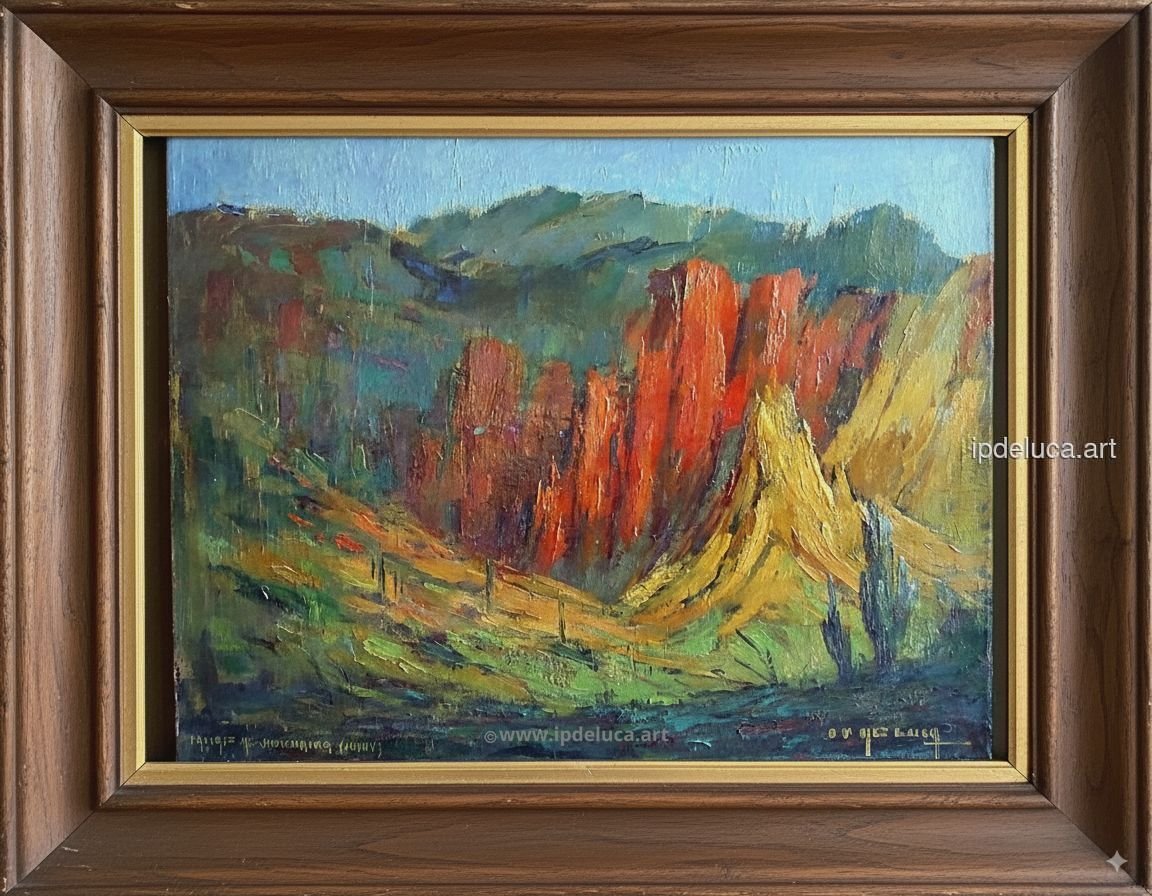
Landscape Painting
Repetto also specialized in landscape painting, applying his observational skills and technical training to natural subjects:
Engineering Perspective on Nature
His engineering background enhanced his landscape painting through:
Understanding of structural principles in natural forms
Analytical observation of geological and botanical elements
Precise rendering of architectural elements in landscapes
Mathematical understanding of perspective and atmospheric effects
Argentine Landscape Interpretation
His landscape work contributed to Argentine art by providing:
Technical precision in representing national scenery
Unique perspective combining engineering and artistic observation
Professional quality that elevated landscape painting standards
Distinctive approach that set his work apart from purely academic training
International Recognition and Collections
Global Museum Representation
Armando E. Repetto achieved remarkable international recognition, with his work represented in museums and collections across multiple continents:
South American Collections
Argentina: Multiple provincial and national museums
Uruguay: Cross-border recognition in neighboring country
Brazil: International Latin American appreciation
European Recognition
Czechoslovakia: Eastern European museum inclusion
England: British institutional collection
This international museum presence demonstrates:
Universal appeal of his artistic approach
Quality standards meeting international museum criteria
Cultural diplomacy value of Argentine art
Lasting significance beyond regional appreciation
Specific Argentine Museum Holdings
Repetto’s work is represented in major Argentine museums:
Pedro de Mendoza Museum of Fine Arts, Buenos Aires
This Buenos Aires museum representation provides:
Capital city recognition in the art center of Argentina
Accessibility to the largest Argentine art audience
Historical documentation of mid-20th century Argentine art
Educational resource for art students and researchers
Bellas Artes Museum, Bolívar
Provincial museum inclusion demonstrates:
National rather than local artistic significance
Appeal across different Argentine regions
Commitment to cultural decentralization
Regional artistic appreciation
Juan B. Castagnino Museum, Rosario
Rosario museum representation confirms:
Recognition in Argentina’s second most important art city
Professional standing among major Argentine collections
Historical significance for future generations
Quality validation by professional curators
Final Exhibition and Career Conclusion
Last Exhibition in Mar del Plata (1967)
Armando E. Repetto’s final exhibition took place in 1967 at the Kaperotxipi Gallery in Mar del Plata, just one year before his death. This final exhibition was significant because:
Coastal City Connection
Mar del Plata, Argentina’s premier coastal resort, provided:
Different audience from his usual Buenos Aires exhibitions
Vacation atmosphere conducive to art appreciation
Coastal themes possibly relevant to his maritime family background
Final artistic statement in a distinctive setting
Career Summation
This 1967 exhibition represented:
Lifetime artistic achievement summary
Final public presentation of his artistic development
Career conclusion after nearly three decades of professional painting
Artistic legacy establishment before his 1968 death
The Engineer-Artist Model
Unique Professional Integration
Armando E. Repetto created a unique model for combining professional engineering with serious artistic practice:
Financial Stability for Artistic Freedom
His engineering background provided:
Economic security allowing artistic risk-taking
Professional credibility supporting art career development
Analytical skills enhancing artistic technique
Technical knowledge applicable to artistic materials and methods
Artistic Enhancement of Engineering Perspective
His artistic development enhanced his engineering capabilities through:
Interdisciplinary approaches to creative development
Career flexibility and portfolio careers
Technical skills enhancement of artistic practice
Professional Inspiration
His example continues to inspire:
Engineers exploring artistic interests
Artists seeking technical precision
Career changers at any life stage
Dual-career professionals in creative fields
Armando E Repetto civil engineer painter Argentina still life landscape Müller Gallery.
Conclusion: The Renaissance Professional
Armando E. Repetto (1893-1968) exemplifies the Renaissance ideal of the complete professional, successfully integrating civil engineering expertise with serious artistic achievement. His journey from three months of childhood art training to international museum recognition demonstrates that artistic excellence can develop alongside technical professions.
As a colleague of I.P. De Luca, Repetto brought unique perspectives to the artistic community of mid-20th century Argentina. His family artistic heritage—from his painter father and ship figurehead carving grandfather—combined with his engineering education to create an artist capable of remarkable technical precision and commercial success.
The complete sale of his 1940 debut exhibition and his subsequent regular exhibitions with critical and public support prove that non-traditional artistic paths can achieve the same recognition as conventional academic training. His presence in museums across Argentina, Uruguay, Brazil, Czechoslovakia, and England confirms that his unique approach achieved truly international artistic significance.
Repetto’s specialization in still life and landscape painting allowed him to apply his engineering precision to artistic subjects, creating works of remarkable technical excellence and aesthetic appeal. His final exhibition in Mar del Plata in 1967 represented the culmination of a 30-year professional artistic career that proved artistic success is not limited to those with extensive formal training.
The legacy of Armando E. Repetto continues to inspire engineers interested in art, self-taught artists seeking recognition, and anyone considering non-traditional paths to artistic achievement. His career demonstrates that technical training, family artistic heritage, and personal dedication can combine to create artistic careers of lasting significance and international recognition.
This article is part of the series dedicated to the colleagues and contemporaries of I.P. De Luca, distinguished painters who contributed to the development of Argentine art in the 20th century.
We use cookies to ensure that we give you the best experience on our website. If you continue to use this site we will assume that you are happy with it.



 Optimized by Seraphinite Accelerator